
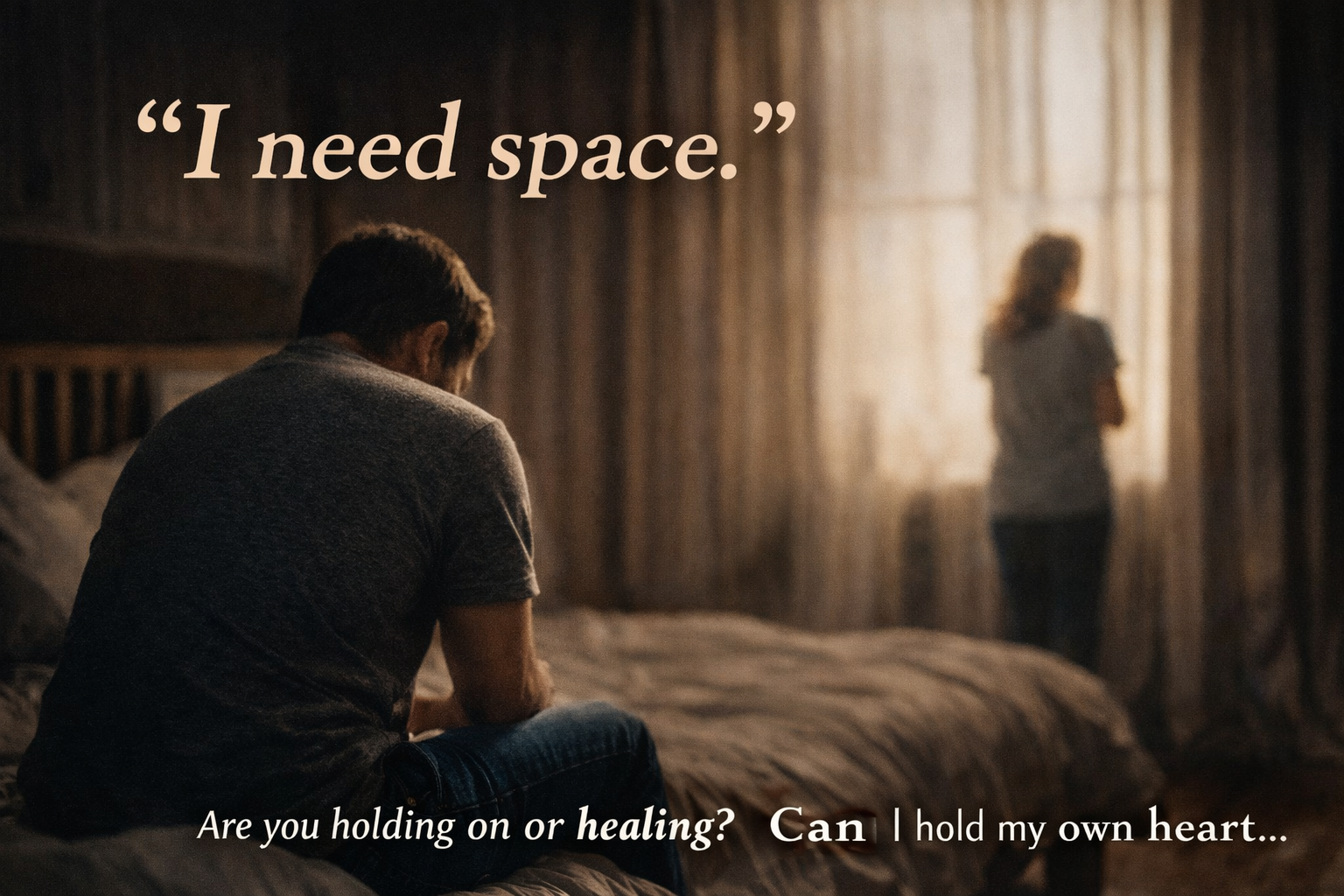
There’s a specific kind of panic that hits when the person you love says, “I need space.”
Not “I’m leaving forever.” Not “I hate you.” Just… space.
And somehow that one word can turn your nervous system into a 24/7 emergency broadcast. You start watching your phone like it’s a heart monitor. You replay your last conversation in slow motion. You bargain with yourself:
If I give them 3 days, will they miss me?
If I don’t text, will they think I don’t care?
If I DO text, will I ruin everything?
How long is too long?
I get it. I’ve lived this in my own way, and I’ve also walked with hundreds of people through it.
And here’s the truth most people don’t want to hear at first:
When you keep asking “How long should I wait?” you’re usually asking the wrong question, and it can quietly sabotage the very reconnection you’re hoping for.
So let me walk you through what I wish someone had sat me down and explained in plain language, not fluffy advice, not manipulation, not “just be confident”, but what actually moves the relationship forward when your partner wants space.
Why “How Long?” Keeps You Stuck (Even If You Mean Well)
If I give them 3 days, will they miss me?
If I don’t text, will they think I don’t care?
If I DO text, will I ruin everything?
How long is too long?
When you ask “How long,” you’re not really asking about time.
You’re asking for certainty.
You’re asking for something to hold onto so your chest stops feeling tight.
You’re trying to soothe the fear that you’re losing them… and you’ll never get them back.
But the moment your focus becomes the timeline, you start living in an outcome-obsessed state, and that state changes how you show up.
I used this analogy because it’s exactly what it feels like:
It’s like watching a plant grow; if you stare at it all day, you swear it’s not growing at all. You get impatient. You start messing with it. You check the soil. You poke it. You move it into a different light. You overwater. You under-water.
And that’s what “How long?” does to your relationships.
The more you focus on how quickly things will change, the more anxious and impatient you become, and even when you try not to be pushy, that impatience leaks out.
Not always in obvious ways.
Sometimes it shows up in your tone.
In your pacing.
In your “casual” texts that aren’t casual at all.
In your micro-expressions.
In that subtle edge of desperation, you don’t even realize you’re carrying.
And partners feel that. They sense it. They pull away even more.
What “Space” Usually Means (That People Miss)
When someone asks for space, most people treat it like a negotiation:
“Okay, how much space? How long? What are the rules? Can we still talk? Can we still see each other? Is this a breakup?”
But most of the time, “space” isn’t a strategy.
It’s a symptom.
Because when your partner asks for space, there’s usually some deep-seated unhappiness — something missing, something heavy, something unresolved, and they often can’t fully explain it. Sometimes they aren’t even fully aware of what it is yet.
And if you rush to “fix it,” you can end up fixing the wrong thing.
You can end up cutting the weed off at the surface… but never pulling it out by the roots.
So it grows back.
Bigger.
Stronger.
Meaner.
And now you’re shocked because you thought you were doing better… but the relationship keeps looping back into the same pain.
That’s why space can feel so confusing: your partner isn’t always reacting to what you did last week; they’re reacting to the accumulation of what hasn’t been healed.
So the real question becomes:
Are you trying to get them back… or are you willing to understand what made them need distance in the first place?
The One Shift That Changes Everything
Here’s the shift that separates “temporary improvement” from real transformation:
Stop using growth as a tactic. Start using growth as a lifestyle.
A lot of people try to better themselves to get their partner back.
And listen, I’m not judging that. When you’re scared, you’ll do whatever you can to stop the pain.
But if your motivation is tied to the outcome, you’ll lose your motivation the moment the outcome changes.
Meaning:
If they come back, you relax… and the old patterns return.
If they don’t come back fast enough, you spiral… and the anxious behavior returns.
Either way, the relationship becomes a swing between fear and relief, not emotional safety and stability.
The real shift happens when you start bettering yourself for your own sake, regardless of what they do.
Because when you do that, your actions become less manipulative (even unintentionally), and your partner can begin to believe your changes are real, not a performance.
And that’s when trust starts to rebuild.
The Four Questions That Actually Move the Relationship Forward
So if “How long should I wait?” is the wrong question…
What should you be asking instead?
These are the four questions I teach people to pivot toward, because they shift your focus from anxiety to real repair.
1) “How long will it take for me to better myself for the sake of bettering myself?”
This isn’t motivational fluff. This is the foundation.
Because if you only grow to win them back, your growth has an expiration date.
But if you grow because you truly want to change, because you value who you’re becoming, then you keep going even after you get what you want.
That’s what creates permanent change.
And permanent change is what makes reconnection stable, not temporary.
Ask yourself honestly:
Am I doing this because I’m afraid of losing them… or because I’m tired of losing myself?
That question right there can wake you up.
Because your partner isn’t looking for grand gestures.
They’re looking for consistency.
They’re looking for who you are when no one is watching.
And yes, paradoxically, they’re always watching.
2) “How long will it take for me to learn the skills to lead conversations that open up my partner and heal their emotions?”
If your partner wants space, there’s a strong chance they don’t feel emotionally safe.
Not necessarily because you’re a “bad person,” but because the relationship dynamic has trained their body to brace.
A lot of people think they know how to communicate.
But if your partner shuts down, avoids, stonewalls, or keeps asking for space, then there are probably skills you haven’t built yet.
You need to learn how to:
Ask questions that don’t corner them
Listen without rushing to fix
Lead with calm instead of urgency
Create a tone that feels safe enough for the truth to come out
Because when you can lead conversations that make them feel safe, your partner can finally share what’s really been going on, and then you finally understand what actually needs to change.
And that’s where real progress starts.
Not from guessing.
Not from mind-reading.
Not from trying random tips online.
But from learning how to create emotional safety in real time.
3) “How long will it take for me to learn to battle the resistance without losing myself?”
This one is huge, because it’s where most people fail.
You can start doing “everything right”… and your partner can still resist you.
And that resistance is normal.
Why? Because they’re trying to figure out if your changes are real or if this is just a temporary version of you meant to pull them back in.
If they’ve been burned before, why wouldn’t they resist?
If they’ve seen you change for a week, then relapse into the same patterns…
If they’ve heard promises and apologies that didn’t hold…
If they’ve given chance after chance and it kept costing them…
Resistance becomes self-protection.
So the question becomes:
Can you keep showing up authentically, even when it’s hard?
Because that’s what proves you’re different.
Most people give up here because they’re still focused on quick results and immediate validation.
But if you can face the resistance, you get over the hump and things move faster than you’d expect, because you’re finally operating from authenticity.
4) “How long before I stop needing them to believe me… and start becoming undeniable?”
I know what you’re thinking, because I’ve heard it a thousand times:
“Okay, but how long before they believe I’ve changed for good?”
Here’s the reality:
Ultimately, it’s their choice.
They need to believe your growth is genuine and lasting, not a strategy.
And you can’t force that.
But what you can do is master the first three questions:
Grow for real
Learn how to communicate safely
Keep showing up through resistance
And then something ironic happens:
When you stop attaching yourself to the outcome… that’s often when things start progressing the fastest.
Not because you “played hard to get.”
But because your energy changes.
Your nervous system stops broadcasting panic.
You stop trying to extract reassurance.
You become grounded.
And grounded people feel safer to come back to.
What To Do While You’re “Giving Space” (So You Don’t Waste It)
Space doesn’t mean you disappear into numbness.
Space means you stop chasing the outcome and start building the person who can sustain the relationship if it returns.
Here’s what I want you to focus on while your partner is taking space:
Regulate your body before you regulate the relationship.
If you’re constantly anxious, your communication will carry that anxiety, even if your words seem “fine.”Stop auditioning. Start transforming.
Don’t do “fake growth” that collapses once you get a little closeness back. That only prolongs the separation.Practice emotional leadership.
Your partner doesn’t need you to be perfect. They need you to be steady.Respect their distance without punishing them for it.
Space is not a weapon. It’s a boundary. Treat it like one.
And if you feel yourself slipping back into obsessive thoughts, come back to this:
The timeline is not your job. The transformation is.
If You’re Reading This With a Lump in Your Throat…
If you’re the one sitting in the silence right now…
If your home feels unfamiliar…
If you’re terrified that giving space means you’re about to lose everything…
I want you to hear me clearly:
You’re not powerless.
But your power isn’t in chasing them.
Your power is in becoming the version of you that doesn’t need to beg for love… because you’re finally living in a way that creates safety.
And that starts when you stop asking “How long?” and start asking the questions that build real change.
Want My Help Rebuilding This the Right Way?
If this hit home and you’re ready to stop guessing and start doing the work that actually restores relationships, I invite you to join my Relationship Restoration program.
No gimmicks. No quick fixes. No manipulation.
Just real, science-based strategies that focus on emotional safety, deep change, and lasting repair.
Because your relationship doesn’t need more pressure.
It needs more truth.
And it needs a version of you that’s ready to lead with it.